Uromastyx are sun-loving, plant-eating desert lizards from North Africa and the Middle East that grow 9 to 30 inches depending on species and can live more than 25 years. Most need an enclosure of at least 4 × 2 × 2 feet, a basking surface of 120 to 130°F, a cool side around 85°F, strong UVB giving a UV index of 4.5 to 6, humidity of just 20 to 30%, and at least 4 inches of packed sand to dig in. Feed mostly leafy greens and flowers, daily for juveniles and 4 to 5 times a week for adults.
In this guide
Uromastyx quick facts
| Scientific name | Uromastyx spp. |
|---|---|
| Also called | Spiny-tailed lizard, mastigure, uro |
| Experience level | Intermediate |
| Adult size | 9–30 in (23–76 cm), by species |
| Lifespan | 25+ years, possibly up to 60 |
| Activity | Active by day |
| Adult enclosure | 48 × 24 × 24 in (120 × 60 × 60 cm) minimum; larger for big species |
| Basking spot | 120–130°F (49–54°C) surface |
| Cool side | About 85°F (29°C) |
| Humidity | 20–30%, with a damp burrow |
| UVB | 14% T5 HO tube, UVI 4.5–6 at the basking spot |
| Diet | Herbivore: greens, flowers, a few seeds |
| Feeding | Juveniles daily; adults 4–5× a week |
| Housing | Alone |
Is a uromastyx the right pet for you?
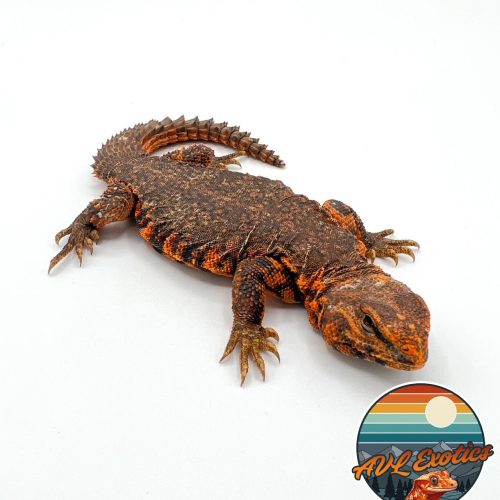
Uromastyx are chunky, round-headed lizards with heavy, spiked tails, and they are among the most heat-loving reptiles you can keep. In their desert homes across North Africa and the Middle East, they bask even through the hottest part of the day, climb rock piles and dig burrows. They are active by day and eat almost entirely plants.
There are about 20 species and subspecies, ranging from 9 to 30 inches (23 to 76 cm) long, in colors from tan and gray to vivid blue and green. The ones most often kept as pets are U. dispar maliensis, U. geyri and U. ornata ornata, all around 15 inches (38 cm). Other species tend to be wild caught, so a captive-bred animal is the better choice.
With good care a uromastyx can live more than 25 years, possibly as long as 60, so it is a long commitment. Individuals vary: many tame down well and become rewarding, calm pets, while a few never enjoy handling.
Uromastyx enclosure size
Most uromastyx need an enclosure of at least 4 × 2 × 2 feet (120 × 60 × 60 cm), but the size depends on the species. As a rule, the enclosure should be about 6 times the lizard’s snout-to-vent length long and twice it wide and tall, and at least 18 inches (46 cm) high. If you only know the total length, aim for at least 3 times that length.
| Adult total length | Minimum enclosure |
|---|---|
| Up to 18 in (46 cm) | 4 × 2 × 2 ft (120 × 60 × 60 cm) |
| Up to 24 in (61 cm) | 6 × 2 × 2 ft (180 × 60 × 60 cm) |
| Up to 30 in (76 cm) | 8 × 3 × 3 ft (240 × 90 × 90 cm); at least 8 × 4 × 4 ft (240 × 120 × 120 cm) for U. aegyptia |
Larger is better. Choose a front-opening enclosure with good ventilation, ideally with a mesh top for the lamps.
Can uromastyx live together? Some keepers house a pair or one male with several females, but that needs at least double the minimum space and may still fail. Uromastyx are happy alone, so one per enclosure is best.
Temperatures and heating
Give your uromastyx a basking surface of 120 to 130°F (49 to 54°C) under the lamps and a cool zone of about 85°F (29°C) at the far end, so it can move between them to control its temperature.
Halogen flood bulbs are the best heat source. Two 100 watt bulbs side by side in a dual dome fixture usually reach the right temperature when the top of the basking platform sits about 10 to 12 inches (25 to 30 cm) below them. If the surface runs too hot, lower the platform or use a plug-in lamp dimmer; if it is too cool, use higher-wattage bulbs.
The best basking platform is a stack of flat stone or wood pieces, such as flagstone or slate, separated by spacers. The gaps between layers make snug crevices where your uromastyx feels safe while choosing exactly how warm it wants to be.
Check the basking surface with an infrared temperature gun, and keep a digital probe thermometer with its probe on the basking surface to track it day to day.
Lighting and UVB
Uromastyx need strong UVB to survive: a UV index (UVI) of 4.5 to 6.0 at the basking spot. Use a 14% T5 HO UVB tube in a reflective fixture, about half as long as the enclosure and mounted over the warm side. Set the basking platform so your uromastyx’s back is about 8 to 12 inches (20 to 30 cm) below the tube if it sits above a mesh top, or 14 to 19 inches (36 to 48 cm) below it with no mesh in between. A UV index meter is the most reliable way to find the right spot.
These lizards also need bright, white daylight. Uromastyx kept with extra lighting of about 6500K are noticeably more alert and active, eat better and behave more naturally. A UVB tube does not provide this, so add an LED daylight bar long enough to cover most of the enclosure, or several shorter ones, and run all the lights on a timer.
Humidity and water
Uromastyx need very dry air: about 20 to 30% humidity, measured with a digital hygrometer probe on the floor of the cool side. Humidity that stays higher than this can make them ill.
They do benefit from a humid retreat underground. Your uromastyx will usually dig its own burrow, so pour a little water into the substrate now and then to keep burrows from collapsing and to keep them moist inside. Keep the top inch (2.5 cm) of substrate dry.
A few coastal species are exceptions. U. yemenensis needs around 50% humidity and U. macfadyeni about 30 to 35%, and both may appreciate a light misting at night.
Uromastyx get most of their water from food, but always keep a small bowl of fresh water in the enclosure. In a well-ventilated enclosure it will not raise humidity enough to cause problems.
Best substrate for uromastyx
Pack at least 4 inches (10 cm) of fine sand or a sandy soil into the enclosure, and more if you can. A 4 × 2 × 2 foot enclosure needs at least 2.5 cubic feet of substrate.
- Good choices: fine natural desert sand, play sand, or a homemade blend of half play sand with organic topsoil (30%) and burrowing clay (20%), which helps tunnels hold their shape.
- Sick or injured lizards: keep them on paper towels until they recover.
Remove droppings and urates daily along with the soiled sand, and replace the substrate completely every 3 to 4 months.
Décor and enrichment
A sparse enclosure wastes space. Fill it with enough décor to give your uromastyx plenty of places to hide, climb and explore:
- A hide or reptile cave, plus cork hollows and cork flats
- Climbing wood such as cholla, ghost wood or grapevine
- Ledges and a 3D background to use the walls
- Drought-tolerant, nontoxic live plants, though expect them to be eaten and need replacing
What do uromastyx eat?
Uromastyx are herbivores. Feed juveniles every day, as much as they will eat, and adults 4 to 5 times a week. About 90% of the diet should be leafy greens and flowers, about 5% hard vegetables and treats, and about 5% dry foods. Variety is the key to a balanced diet.
- Greens: collard, mustard and turnip greens, dandelion greens, kale, bok choy, arugula, spring mix, curly endive, frisée, radicchio and treviso, romaine and green leaf lettuce, spinach, carrot tops, alfalfa, pea shoots, cactus pads, clover, grape and hibiscus leaves, grass, bindweed and broadleaf plantain. Pesticide-free weeds gathered outdoors are even better than store-bought greens.
- Flowers: dandelion, clover, hibiscus, rose, nasturtium, phlox, honeysuckle, squash blossoms, bindweed and sunflower petals. Offer as many as your uromastyx wants, especially in spring, but never flowers from a florist, which may be treated with chemicals.
- Hard vegetables, cooked or finely shredded: acorn, butternut and spaghetti squash, zucchini, carrot, green beans, peas and prickly pear pads.
- Dry foods: a good commercial herbivore diet or dried grass hay sprinkled over the salad, dry or soaked if your uromastyx needs extra water.
- Seeds: uromastyx need a few seeds, such as lentils or white millet, for protein and fat. Give a small amount no more than once a week, as too much leads to obesity.
Treats. An occasional insect adds nutrients: a single mealworm or superworm, at most weekly for a juvenile and every other week for an adult, dusted with an equal mix of calcium and multivitamin. Too much protein causes health problems. Fruit such as figs, papaya, berries, apple, cherries or prickly pear is sugary, so limit it to one piece a month.
Supplements. Sprinkle a calcium powder and a multivitamin powder, or an all-in-one plant-eater supplement, on the greens twice a week. Bee pollen is often overfed; edible flowers supply pollen naturally.
Handling your uromastyx
Most uromastyx tame down with patience, though some take much longer than others and a few never do. Captive-bred animals tame more easily than wild-caught ones, and juveniles are much jumpier than adults.
- Leave a new uromastyx alone for about 2 weeks to settle in. If it has not eaten by then, do not handle it, and book a visit with a reptile vet.
- Offer food from your fingers or soft-tipped tongs, and put your hands in the enclosure every day for spot-cleaning and water changes so it gets used to you.
- Once it takes food from your hand reliably, hold the food so that reaching it means stepping onto your hand.
To pick it up, scoop it gently from underneath, supporting most of its body. Never approach quickly or from above, which is how a predator strikes. Move slowly and hold loosely, if at all. Letting it walk from one hand to the other helps a nervous lizard burn off energy.
Health and common problems
Most health problems in uromastyx come from husbandry mistakes, so the setup is your best protection:
- High humidity: air that stays above about 30% (higher for coastal species) can make a uromastyx sick.
- Weak UVB or poor lighting: uromastyx cannot stay healthy without strong UVB and bright light.
- Obesity: usually from too many seeds, too much fruit or too many insects.
- Not eating: a new lizard that has not eaten after 2 weeks, or any uromastyx that stops eating, needs a vet visit.
Find an experienced reptile vet before you need one, and move any sick or injured uromastyx onto paper towels while it recovers.
Uromastyx setup checklist
- Front-opening enclosure sized for your species, 4 × 2 × 2 ft or larger, with a mesh top
- Dual dome fixture with two 100 watt halogen flood bulbs
- Flat stones or slate and spacers for a stacked basking platform
- 14% T5 HO UVB tube about half the enclosure length, in a reflective fixture
- LED daylight bar covering most of the enclosure
- Outlet timer and a plug-in lamp dimmer
- Infrared temperature gun and a digital thermometer and hygrometer
- Fine sand or a sand, soil and clay mix for at least 4 inches of depth
- A hide, cork pieces, climbing wood and ledges
- Food dish and small water bowl
- Calcium and multivitamin powders
Getting set up? Find what you need in our shop: Live lizards, Enclosures, Heating & Lighting, Substrate & Bedding, Décor & Hides, Food & Feeders, Supplements. Questions about your setup? Ask us, in the shop in Asheville or online.
Uromastyx FAQ
How big do uromastyx get?
It depends on the species. Uromastyx range from 9 to 30 inches (23 to 76 cm), and the species most often kept as pets reach about 15 inches (38 cm).
How long do uromastyx live?
With good care, uromastyx can live more than 25 years, possibly as long as 60.
What size tank does a uromastyx need?
At least 4 × 2 × 2 feet (120 × 60 × 60 cm) for species up to 18 inches long. Larger species need 6 × 2 × 2 to 8 × 4 × 4 feet.
What do uromastyx eat?
They are herbivores. About 90% of the diet should be leafy greens and flowers, with small amounts of hard vegetables, dry herbivore food and seeds. Insects and fruit are occasional treats only.
Do uromastyx need UVB?
Yes. They need strong UVB from a 14% T5 HO tube, giving a UV index of 4.5 to 6 at the basking spot, plus bright daylight lighting.
Do uromastyx need water?
They get most of their water from food, but you should always keep a small bowl of fresh water in the enclosure.
Sources: ReptiFiles, Uromastyx Care Sheet. This guide is general care information, not veterinary advice. If your animal seems unwell, see a reptile veterinarian.