Fire skinks are colorful, burrowing forest lizards from west central Africa that grow up to 12 to 15 inches and can live 15 to 20 years. One needs an enclosure of at least 36 × 18 × 18 inches with 4 to 6 inches of damp, soil-like substrate, a basking spot of 92 to 96°F, a cool side of 75 to 85°F, UVB and humidity of 60 to 70%. Feed a varied diet of calcium-dusted insects, daily or every other day for juveniles and twice a week for adults.
In this guide
Fire skink quick facts
| Scientific name | Mochlus fernandi |
|---|---|
| Also called | African fire skink |
| Experience level | Intermediate |
| Adult size | Up to 12–15 in (30–38 cm) |
| Lifespan | Up to 15–20 years |
| Activity | Active by day, most of all morning and late afternoon |
| Adult enclosure | 36 × 18 × 18 in (90 × 45 × 45 cm) minimum |
| Basking spot | 92–96°F (33–36°C) |
| Cool side | 75–85°F (24–29°C) |
| Night | 70–75°F (21–24°C) |
| Humidity | 60–70% |
| UVB | 5–6% T5 HO tube, UVI 3–4 at the basking spot |
| Diet | Insects and other invertebrates, some small vertebrates |
| Feeding | Juveniles daily or every other day, adults twice a week |
| Housing | Alone, or females together in a large enclosure |
Is a fire skink the right pet for you?
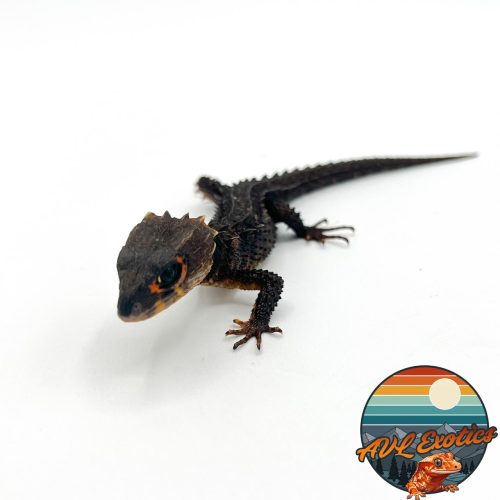
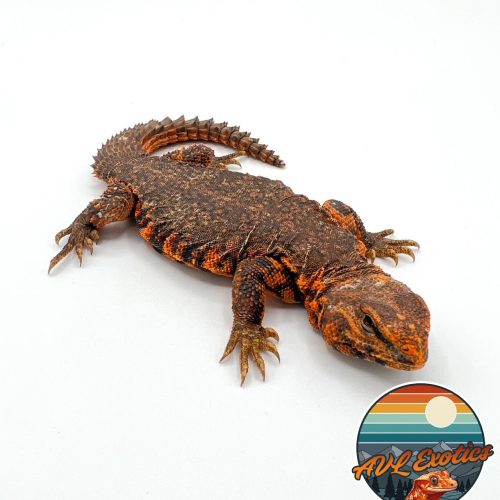
Fire skinks are among the most striking skinks you can keep. The glossy body is red and bronze with black markings and fine white speckles, set off by black legs and eyes and a belly barred in black and white. They have the classic skink shape: long and solid, with short, strong legs. Adults reach up to 12 to 15 inches (30 to 38 cm), and with good care a fire skink can live 15 to 20 years.
In the wild they live in the forests of west central Africa, active by day but never far from their burrows. They are busiest in the morning and late afternoon.
Fire skinks are mainly a pet to watch rather than handle. Captive-bred animals tend to be bolder and more active than wild-caught ones, and they reward a well-planted, naturalistic enclosure with plenty of digging and exploring.
Fire skink enclosure size
One fire skink needs an enclosure of at least 36 × 18 × 18 inches (90 × 45 × 45 cm), and larger is strongly recommended. A skink that grows to 15 inches needs room to explore, hunt and dig, and space for a proper warm-to-cool gradient. A front-opening enclosure makes care and feeding easier.
Can fire skinks live together? They are solitary and perfectly happy alone. Females can sometimes share an enclosure if it is big enough for each to have its own space, but never house two males together.
Temperatures and heating
Fire skinks need a basking spot of 92 to 96°F (33 to 36°C), a cool zone of 75 to 85°F (24 to 29°C) and nights of 70 to 75°F (21 to 24°C). Like all reptiles, they control their body temperature by moving between warm and cool areas, so the enclosure needs both.
Heat lamps. Wild fire skinks warm up in the sun, and a white heat lamp is the best stand-in. One or two halogen bulbs of about 50 watts, in a dome fixture with a ceramic socket, are usually enough. Results depend on your room temperature: if the basking spot runs too hot, dim the lamp or switch to a lower-output incandescent bulb, and if it runs too cool, step up the wattage.
Measuring. Use two digital probe thermometers, one with the probe on the basking surface and one at the cool end, so you can see the whole gradient at a glance.
Lighting and UVB
Fire skinks are active by day, so give them a regular 12 hours of light and 12 of darkness. They can survive without UVB if they get plenty of vitamin D3 from supplements, but they do better with UVB, and we recommend it.
Aim for a UV index (UVI) of 3 to 4 at the basking spot. In an 18-inch tall enclosure, a 22-inch, 5 to 6% T5 HO tube in a reflective fixture does the job. Mount it over the warm side, overlapping the heat lamp, and make it about half the length of the enclosure. With the tube on top of a mesh lid, set the basking surface so the skink’s back is 8 to 10 inches (20 to 25 cm) below it. That distance is only a guide, so check with a UV index meter if you can. Replace the tube every 12 months, as its UVB fades over time.
Daylight. Heat and UVB lamps are dim compared with sunlight. A bright, 6500K LED grow light makes the enclosure feel like daytime and can boost activity, appetite and long-term health, even if you have no live plants.
Humidity and water
Keep the average humidity for a fire skink at 60 to 70%, measured with a digital hygrometer probe in the middle of the enclosure.
- Mist the enclosure with a pump sprayer every morning and evening, and at midday too if needed, or fit an automatic misting system.
- Make sure there is enough ventilation for the enclosure to dry slightly between mistings.
- If humidity drops too low at night, run a reptile fogger or humidifier after dark, ideally on a humidistat. Fill it only with distilled or reverse osmosis water, and clean and disinfect it every week.
Drinking water. Always have a small dish of fresh water in the enclosure, and scrub it with a reptile-safe disinfectant once a week.
Best substrate for fire skinks
Fire skinks love to burrow and spend a lot of time in their tunnels, so give them 4 to 6 inches (10 to 15 cm) of moisture-holding substrate that resembles tropical forest soil. It also helps keep humidity steady and gives the skink a naturally damp place to retreat to.
- A mix of 40% organic topsoil, 40% coconut fiber and 20% fine sand
- A ready-made reptile soil or plain coconut fiber
For a 36 × 18 inch floor, plan on roughly 45 to 67 quarts. Remove droppings and urates every day, along with any soiled substrate, and replace the whole lot every 3 to 4 months.
Hides and décor
Décor gives a fire skink exercise, cover and things to investigate, so be generous with it. Provide at least two hides, then add:
- Rock stacks, fixed in place so they cannot topple
- Hollow logs and cork flats
- Broad, low branches to clamber over
- Extra hides
- Live or artificial plants
Lay it all out so there is plenty to climb and explore, lots of shelter, and a mix of bright and shaded areas.
What do fire skinks eat?
Fire skinks are insectivores that need a varied diet. Feed juveniles every day or every other day and adults twice a week. At each meal, offer as many insects as the skink eats in about 5 minutes, each no bigger than its head.
Good feeders: crickets, dubia and discoid roaches, isopods, earthworms, hornworms, silkworms, mealworms, superworms, and the beetles of both. Feeder geckos and feeder anoles can be offered too. Treats: pinky mice, quail eggs and berries.
Variety is the most important thing you can give. The more different foods your skink eats, the better balanced its nutrition will be.
Supplements. Dust insects lightly with calcium powder before every feeding to correct their low calcium, and add a multivitamin to the routine to prevent deficiencies. An all-in-one calcium and multivitamin powder is an easy way to start. Follow the label.
Handling your fire skink
Fire skinks are best treated as a look-but-do-not-touch pet. Some calm down and tolerate gentle handling, but they are quick and slippery, so handle with care, low over a soft surface, if at all.
Give a new skink at least 2 weeks to settle before you try to interact. After that, the best way to build trust is to offer insects and treats from soft-tipped feeding tongs, so the skink comes to link you with food.
Health and common problems
Most health problems in fire skinks start with the setup, so check temperatures, humidity and UVB first whenever something seems off. Weigh your skink regularly and keep notes on its appetite and behavior, so you notice changes early.
- Not eating: check the basking temperature first, as a skink that is too cool often loses its appetite.
- Shedding trouble or dehydration: usually means humidity is too low or the substrate has dried out.
- Weak bones: a risk without UVB or regular calcium.
- Obesity: from too much food or too many treats.
Find a reptile vet before you need one, and book a visit if your skink keeps refusing food or loses weight.
Fire skink setup checklist
Have everything in place and running before your skink comes home.
- Front-opening enclosure, at least 36 × 18 × 18 in
- About 50-watt halogen heat bulb in a ceramic-socket dome fixture
- 22-inch 5 to 6% T5 HO UVB tube and reflective fixture
- 6500K LED daylight lamp
- Digital timer for the lights
- Two digital thermometer and hygrometer gauges
- Pump sprayer
- Soil-based substrate, enough for 4 to 6 inches deep
- At least two hides, cork, logs, branches and plants
- Food and water dishes
- Calcium and multivitamin powder
- Soft-tipped feeding tongs
- Reptile-safe disinfectant and a spray bottle
Getting set up? Find what you need in our shop: Live lizards, Enclosures, Heating & Lighting, Substrate & Bedding, Décor & Hides, Food & Feeders, Supplements. Questions about your setup? Ask us, in the shop in Asheville or online.
Fire skink FAQ
How big do fire skinks get?
Adults grow up to 12 to 15 inches (30 to 38 cm) long.
How long do fire skinks live?
With good care, a fire skink can live up to 15 to 20 years.
What size tank does a fire skink need?
At least 36 × 18 × 18 inches (90 × 45 × 45 cm) for one skink, and larger is strongly recommended.
Do fire skinks need UVB?
They can survive on vitamin D3 supplements alone, but they do better with UVB, and we recommend a 5 to 6% T5 HO tube giving a UV index of 3 to 4 at the basking spot.
What do fire skinks eat?
Mostly insects and other invertebrates, such as crickets, roaches, isopods, earthworms and silkworms, dusted with calcium. Feed juveniles daily or every other day and adults twice a week.
Can fire skinks live together?
Females can sometimes share a large enclosure, but males must never be housed together. Fire skinks are solitary and happy alone.
Sources: ReptiFiles, Fire Skink Care Sheet. This guide is general care information, not veterinary advice. If your animal seems unwell, see a reptile veterinarian.