Common chuckwallas are hardy, plant-eating desert lizards from the southwestern United States and northwestern Mexico that grow 10 to 18 inches and can live up to 30 years. One adult needs an enclosure of at least 4 × 2 × 2 feet with stacked rocks to hide and bask on, a basking surface of 110 to 125°F, a cool zone of 78 to 88°F, nights above 65°F, strong UVB giving a UV index of 4.5 to 6, and at least 3 inches of packed sand. Feed mostly greens and flowers, daily for juveniles and 4 to 5 times a week for adults.
In this guide
- Quick facts
- Is a chuckwalla the right pet for you?
- Chuckwalla enclosure size
- Temperatures and heating
- Lighting and UVB
- Winter brumation
- Humidity and water
- Best substrate for chuckwallas
- Rocks, décor and enrichment
- What do chuckwallas eat?
- Handling your chuckwalla
- Health and common problems
- Chuckwalla setup checklist
- FAQ
Chuckwalla quick facts
| Scientific name | Sauromalus ater |
|---|---|
| Also called | Common chuckwalla |
| Experience level | Intermediate |
| Adult size | 10–18 in (25–46 cm), about half of it tail |
| Lifespan | Up to 30 years, possibly more |
| Activity | Active by day; rests through winter |
| Adult enclosure | 48 × 24 × 24 in (120 × 60 × 60 cm) minimum |
| Basking spot | 110–125°F (43–52°C) surface |
| Cool side | 78–88°F (26–31°C) |
| Night | Above 65°F (18°C) |
| Humidity | 15–65%, with a humid hide |
| UVB | 14% T5 HO tube, UVI 4.5–6 at the basking spot |
| Diet | Herbivore: greens, flowers, some dry food |
| Feeding | Juveniles daily; adults 4–5× a week |
| Housing | Alone, or a male with females in extra space |
Is a chuckwalla the right pet for you?
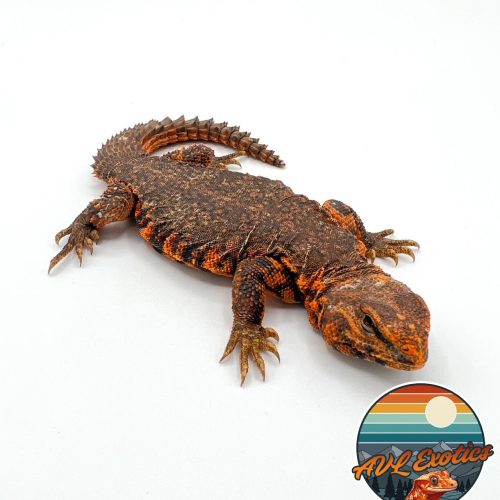
Common chuckwallas are sturdy, mostly docile desert lizards that stay a manageable size and usually tame well,, making captive-bred ones very good pets. Adults are 10 to 18 inches (25 to 46 cm) long, about half of it tail, with a triangular head, a stout, pot-bellied body, folds of loose skin along the neck and sides, and a thick, blunt tail. With good care they can live up to 30 years, possibly longer.
Males vary widely by region, from black-headed with a dark or reddish body and pale tail to speckled or banded gray and yellow. Females are smaller, narrower-headed and plainer brown or gray, and juveniles look like females with bolder bands.
Wild chuckwallas live in the Mojave and Sonoran deserts, from southern Utah and Nevada through western Arizona and southeastern California into Baja California and Sonora. They are active by day and stay close to boulder piles, lava flows and rocky outcrops, wedging into crevices for shelter.
Chuckwalla enclosure size
An adult chuckwalla needs an enclosure of at least 4 × 2 × 2 feet (120 × 60 × 60 cm), or at least 8 square feet (0.75 m²) of floor and 18 inches (45 cm) of height in another shape. Bigger is better. Choose a front-opening enclosure with excellent ventilation, ideally with a mesh top, which makes the lamps easier to mount and move.
Can chuckwallas live together? They can, though they do not need company. For each extra lizard, add at least 12 inches (30 cm) to both the length and width, and give the group several basking spots and extra hides. Never house two males together, as they will fight. A male with females will produce eggs, so only try this with a plan for the eggs. Minor squabbles are normal, but separate the lizards straight away if fighting escalates.
Temperatures and heating
A chuckwalla needs a basking surface of 110 to 125°F (43 to 52°C), a cool zone of 78 to 88°F (26 to 31°C) and nights above 65°F (18°C).
Heat lamps. In a 4 × 2 × 2 foot enclosure, cluster at least two heat lamps to warm a basking area big enough for an adult. Incandescent spot bulbs, around 150 watts to start, give a wide, gentle beam and suit lamps inside the enclosure or over open mesh. Halogen flood bulbs, around 75 watts to start, give a narrower, more intense beam for longer distances or fine mesh. If your chuckwalla avoids the hot spot or it reads too high, lower the platform or the wattage; if it is too cool, raise the wattage or switch to halogens.
Heat mats, heat tape and heated rocks are not suitable basking heat. Use ceramic emitters, heat projectors or radiant panels only as extra background heat if the enclosure runs cool.
The basking stack. Under the lamps, build a stack of flat stones with spacers between them, so your chuckwalla can bask on top or slip into a crevice at the temperature it wants. The bottom layer must sit directly on the enclosure floor, or a digging lizard can undermine it and be crushed.
Check the basking surface with an infrared temperature gun and a digital probe thermometer.
Lighting and UVB
Chuckwallas need strong UVB to survive, with a UV index (UVI) of 4.5 to 6.0 at the basking spot. Use a 22 inch (56 cm) 14% T5 HO UVB tube on the warm side, directly over the heat lamps so light and heat fall together like sunshine. Set the basking stack so your chuckwalla’s back is 9 to 11 inches (23 to 28 cm) below a tube above mesh, or 14 to 16 inches (36 to 41 cm) below one inside the enclosure. A UV index meter confirms the reading. Replace the tube every 12 months, and avoid LED UVB lamps and unknown cheap brands.
Add a bright daylight lamp of about 6000K across most of the enclosure: sun-loving lizards with extra daylight are more alert and eat better. Give at least 12 hours of light a day, or follow the seasons with about 14 hours in summer and 8 to 10 in winter, using a smart timer.
Winter brumation
Wild chuckwallas spend winter in brumation, a cool, inactive rest, and we recommend letting a healthy adult do the same, as it helps keep its hormones in rhythm. A sample northern-hemisphere schedule:
- October 1: stop feeding and begin shortening the day.
- October 15: start reducing basking lamp hours.
- November 1: basking lamps on just 1.5 hours a day, with 8 to 10 hours of daylight.
- January 1: start lengthening the day.
- February 1: 12 to 14 hours of daylight; begin restoring basking time.
- February 15: full basking time; resume feeding.
In the southern hemisphere, run it from February to October. Make every change gradually and keep the enclosure at 48°F (9°C) or warmer. Feeding a brumating chuckwalla is dangerous, as it cannot digest when cold. Only healthy, well-fed lizards should brumate, and one that loses a lot of weight or seems unwell during brumation needs a vet promptly.
Humidity and water
Chuckwallas are not fussy about humidity: anywhere from 15 to 65% suits them, measured with a hygrometer probe resting on the sand at mid-enclosure. A wet enclosure, though, will cause problems.
Provide a humid hide at the cool end, lined with lightly dampened sand or sphagnum moss; a crevice in a cool-end rock stack works well. Chuckwallas get most of their water from food, but keep a small bowl of fresh water available at all times.
Best substrate for chuckwallas
Pack at least 3 inches (8 cm) of fine sand or a sandy soil into the enclosure, and more if you can. A 4 × 2 × 2 foot enclosure takes at least 2 cubic feet, about 190 pounds (86 kg) of sand. Fine natural sand, washed play sand, or a homemade blend of half play sand with organic topsoil (30%) and burrowing clay (20%) all work. Keep a sick or injured chuckwalla on paper towels.
Remove droppings and soiled sand promptly and replace the substrate every 6 to 12 months. Once a year, strip the enclosure, scrub the décor in hot water, and disinfect the walls and floor with a veterinary disinfectant or a 10% bleach solution, rinsed well.
Rocks, décor and enrichment
Rock is the most important décor for a chuckwalla, which lives among boulders, hiding in cracks and climbing and basking on stone. Build stacks of light-colored flagstone, flat sandstone, concrete pavers or even cinder blocks. Anchor each stack to the floor so it cannot shift and crush your lizard, and glue the stones with a strong construction adhesive, leaving a way in so you can reach your chuckwalla quickly.
Add enough extras to give plenty of hiding and climbing options: artificial rock hides, cork flats, climbing wood such as cholla, ghost wood or grapevine, ledges, a 3D background, and drought-tolerant, nontoxic live plants, which will probably get eaten.
What do chuckwallas eat?
Chuckwallas are herbivores. Feed juveniles daily, as much as they will eat, and adults 4 to 5 times a week. Aim for roughly 85% fresh plants (greens and flowers), with dry food making up 10% and the last 5% split between seeds and insects. Variety is essential.
- Greens: collard, mustard and turnip greens, dandelion greens, kale, bok choy, arugula, spring mix, endive, frisée, radicchio, romaine and green leaf lettuce, spinach, carrot tops, alfalfa, pea shoots, cactus pads, clover, grape and hibiscus leaves, grass, bindweed and plantain. Pesticide-free weeds are even better than store-bought greens.
- Flowers, as many as it wants: dandelion, clover, hibiscus, rose, nasturtium, phlox, honeysuckle, squash blossoms and sunflower petals. Never use florist flowers.
- Hard vegetables, cooked or finely shredded: winter squashes, zucchini, carrot, green beans, peas and prickly pear pads.
- Dry foods: a good commercial herbivore diet or grass hay, dry or soaked.
- Seeds: a pinch of lentils or white millet no more than once a week. More leads to obesity.
- Insects: one at most weekly for a juvenile and every other week for an adult, such as a mealworm, cricket or locust, dusted with calcium and multivitamin. Too much protein causes problems.
Make it work for its food by scattering small piles, hiding some, or hanging a bunch of greens and flowers. Sprinkle calcium and multivitamin powders, or an all-in-one plant-eater supplement, on the greens twice a week. Bee pollen is often overfed; flowers supply pollen naturally.
Handling your chuckwalla
Most chuckwallas tame down well, though a few never settle. Captive-bred animals tame more easily, and juveniles are jumpier than adults.
- Leave a new chuckwalla alone for about 2 weeks. If it has not eaten by then, do not handle it; book a reptile vet visit.
- Offer food from your fingers or soft-tipped tongs, and spot-clean by hand every day so it gets used to you.
- Once it takes food from your hand reliably, hold the food where it must step onto your hand to reach it.
To lift it, scoop gently from underneath, supporting most of its body, and never approach fast or from above like a predator. Hold loosely and let it walk from hand to hand so it does not leap away. Wash your hands before and after handling.
Health and common problems
- Weak UVB or lighting: chuckwallas cannot stay healthy without strong UVB and bright light.
- Damp conditions: a wet enclosure causes problems for this desert lizard.
- Obesity: usually from too many seeds or insects.
- Not eating: a new lizard that has not eaten within 2 weeks needs a vet.
If you keep other reptiles, especially other chuckwallas, quarantine a newcomer separately for up to 6 weeks and have a reptile vet check it and test for parasites.
Chuckwalla setup checklist
- Front-opening enclosure of at least 4 × 2 × 2 ft with a mesh top
- Dual dome fixture with two heat bulbs
- Flagstone or pavers, spacers and strong adhesive for rock stacks
- 22 inch 14% T5 HO UVB tube in a reflector fixture
- Daylight LED bar and a smart timer
- Infrared temperature gun and a digital thermometer and hygrometer
- At least 2 cubic feet of fine sand or a sandy mix
- Hides, cork, climbing wood and ledges
- Food dish, small water bowl and supplements
Getting set up? Find what you need in our shop: Live lizards, Enclosures, Heating & Lighting, Substrate & Bedding, Décor & Hides, Food & Feeders, Supplements. Questions about your setup? Ask us, in the shop in Asheville or online.
Chuckwalla FAQ
How big do chuckwallas get?
Common chuckwallas are 10 to 18 inches (25 to 46 cm) long, and about half of that is tail. Females are smaller than males.
How long do chuckwallas live?
With good care, chuckwallas can live up to 30 years, and possibly longer.
What size tank does a chuckwalla need?
At least 4 × 2 × 2 feet (120 × 60 × 60 cm), with plenty of stacked rock. Add at least 12 inches to the length and width for each extra lizard in a group.
What do chuckwallas eat?
They are herbivores. About 85% of the diet should be fresh greens and flowers, with 10% dry herbivore food and 5% seeds and the occasional insect.
Do chuckwallas need UVB?
Yes. They need strong UVB from a 14% T5 HO tube, giving a UV index of 4.5 to 6 at the basking spot, replaced every 12 months.
Do chuckwallas brumate?
Yes. Wild chuckwallas brumate through winter, and a healthy adult benefits from a gradual cool-down with no feeding from about October to mid-February in the northern hemisphere.
Sources: ReptiFiles, Common Chuckwalla Care Sheet. This guide is general care information, not veterinary advice. If your animal seems unwell, see a reptile veterinarian.