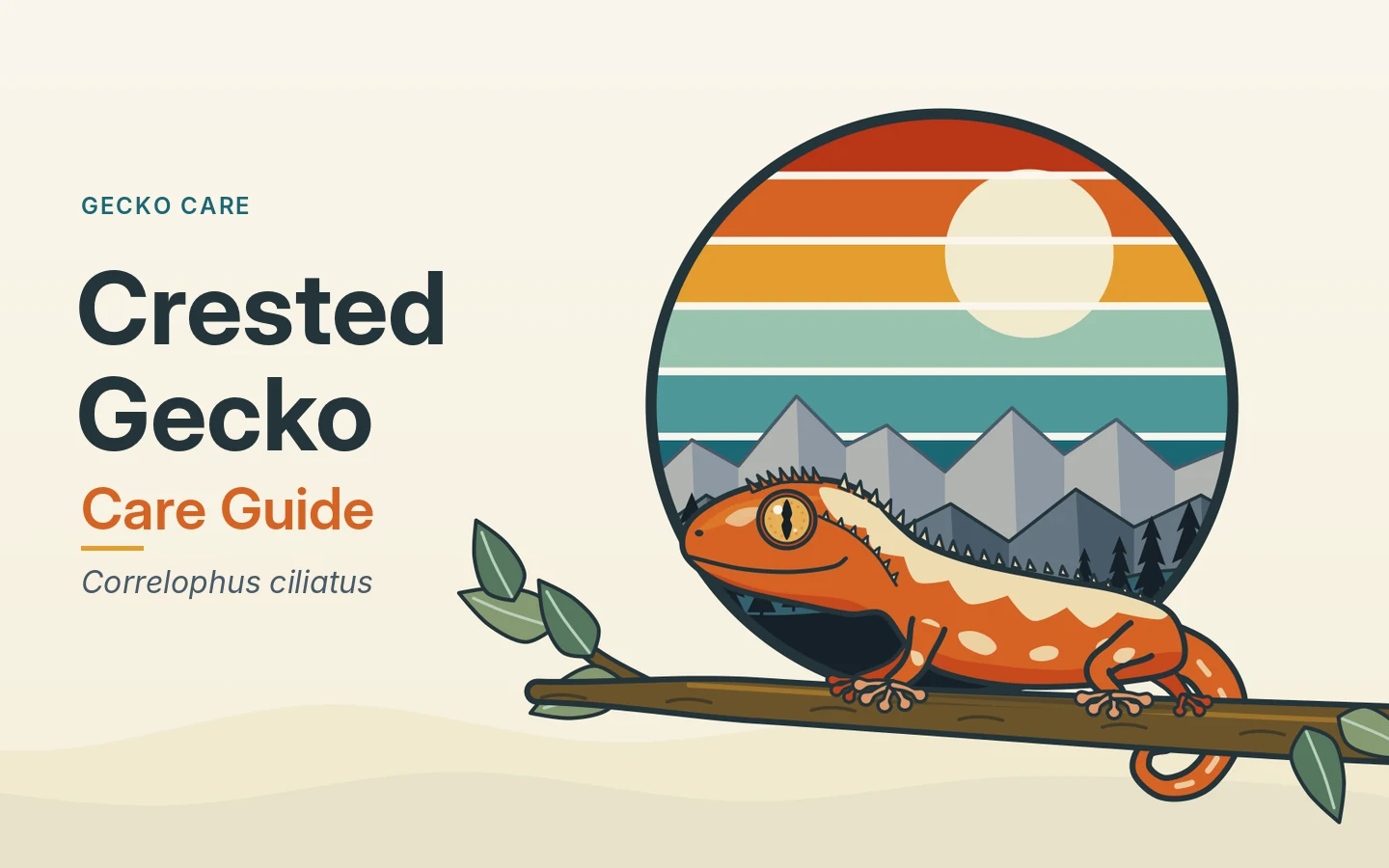
Crested geckos are hardy, easy-going climbing geckos from New Caledonia that live 20 years or more. Keep them at ordinary room temperature, ideally 70 to 78°F, and never above about 82°F, because heat is the one thing that kills them quickly. Mist so the enclosure dries out between sprays, give them a humid hide, climbing cover and a snug hide, and feed a complete powdered crested gecko diet one week and calcium-dusted insects the next, about twice a week. They need no heat lamp and no UVB.
In this guide
- Quick facts
- Why crested geckos make great pets
- Crested gecko temperature: keep them cool
- Crested gecko humidity and the humid hide
- Water and hydration
- Crested gecko enclosure and setup
- Substrate and cleaning
- Lighting: do crested geckos need UVB?
- What do crested geckos eat?
- Handling your crested gecko
- Can crested geckos live together?
- Crested gecko health problems
- Crested gecko setup checklist
- FAQ
Crested gecko quick facts
| Scientific name | Correlophus ciliatus |
|---|---|
| Also called | Eyelash gecko, crestie |
| Experience level | Beginner |
| Adult size | About 8 in (20 cm) including the tail; 35–45 g |
| Lifespan | 20 years or more |
| Activity | Night; hides through the day |
| Temperature | 70–78°F (21–26°C), varying through the day |
| Hatchlings | Low 70s°F by day, high 60s°F at night |
| Danger zone | Stressed above 80–82°F; over 85°F (29°C) can kill |
| Humidity | Around 50–60%, drying out between mistings |
| Lighting | Room light is enough; no UVB needed |
| Diet | Complete powdered diet plus dusted insects |
| Feeding | About twice a week |
| Housing | Alone or in compatible groups; never two adult males |
Why crested geckos make great pets
Crested geckos are one of the easiest reptiles to keep well. They thrive at the same temperatures people find comfortable, so they need no heat lamps, and they rarely get sick when their few simple needs are met. Add a gentle nature, a long life and an enormous range of colors and patterns, and it is easy to see why they are one of the most popular pet geckos in the world.
They come from New Caledonia, a group of islands east of Australia, where they live in forest and spend the day tucked into dark hiding places before coming out at night to climb through thin branches. The species was thought to be extinct until it was found again in 1994. Very few were ever exported, so virtually every crested gecko in the pet trade today is captive bred.
An adult reaches about 8 inches including the tail and weighs 35 to 45 grams. With good care they live 20 years or more, so plan for a long friendship.
Crested gecko temperature: keep them cool
Crested geckos do best at ordinary room temperature, ideally between 70 and 78°F (21 to 26°C), with the temperature rising and falling a little through the day. The cooler end of that range suits them best.
- Hatchlings and babies: keep them in the low 70s by day and the high 60s at night. Young geckos are the most sensitive to heat.
- Adults: tolerate a slightly wider range, but everything, including appetite and breeding, is steadier when they are kept cool.
- Too warm: above 80 to 82°F, smaller geckos lose their appetite and become stressed.
- Dangerous: a few hours above 85°F (29°C) can kill a crested gecko, especially a young one. Signs of overheating include dropping the tail and twitching or other nervous symptoms.
Heat is the crested gecko’s weak spot. Most deaths come from equipment it never needed, such as heat lamps and heat mats, or from sunlight. Keep the enclosure out of direct sun, away from heaters, and never leave a gecko in a hot car, even for a few minutes on the way home.
A digital thermometer in the enclosure tells you what your gecko is actually experiencing. If your home gets hot in summer, move the enclosure to the coolest room, such as a basement.
Crested gecko humidity and the humid hide
Aim for humidity around 50 to 60%, and let the enclosure dry out every day. A humidity cycle, damp after misting and drier later, is healthier than air that stays wet all the time.
Mist the enclosure in the evening, using enough water that most of it has evaporated within 6 to 12 hours. Constantly wet enclosures grow bacteria and mold, and geckos kept too damp can have shedding trouble just like geckos kept too dry. Good ventilation helps. Babies dry out faster than adults, so mist their enclosures more often.
Two signs your gecko needs more moisture: it struggles to stick to smooth surfaces, or old skin stays stuck after a shed.
Give every gecko a humid hide. This is a small, enclosed container filled almost to the top with a damp, mold-resistant mix, so the gecko can squeeze in and sit in moist air whenever it wants. It is the single best way to prevent shedding problems, especially in winter when indoor heating dries the air.
- Use a plastic deli cup or food container with an entrance hole cut in the lid, or cover the top with artificial leaves instead of a lid. In a small tub, a cup about 6.75 inches across and 4.5 inches tall works well; use a bigger one in a bigger enclosure.
- Fill it to within about an inch of the top with equal parts coconut fiber and sphagnum peat, or with long-fiber sphagnum moss. Both resist mold. Paper towels do not, so avoid them here.
- The fuller the hide, the slower it dries out and the safer the gecko feels. Re-dampen it when the mix starts to dry.
Water and hydration
Give your crested gecko a shallow water dish at all times, and mist young geckos daily so they can lick droplets off leaves and glass. Babies often do not drink from a bowl at first, so misting is how they get their water until they learn.
Wrinkled skin is the first sign of dehydration. In severe cases the eyes and head look sunken and the gecko moves stiffly. Fix the cause first by misting more and making the water dish easier to reach. If your gecko still looks dry, put it in a ventilated container lined with paper towels soaked in room-temperature water and wrung out, and leave it there quietly for several hours or overnight. It will drink from the towels and take up moisture through its skin. Never use warm water, and never soak a gecko in standing water, as it can drown.
Crested gecko enclosure and setup
Crested geckos do well in almost any secure enclosure, from a plastic tub to a planted glass terrarium, as long as it offers height for climbing, a snug hide, a humid hide and plenty of cover.
- Size by age: hatchlings do best in small enclosures, where they find their food easily; breeders often raise them in tubs only 5 to 7 inches tall. Adults are commonly kept in large tubs about 12 to 13 inches tall or in display terrariums of around 18 × 18 × 18 inches or more.
- Height versus humidity: a taller enclosure gives more climbing room but holds humidity less well, because there is more air to keep moist. Plan your misting and humid hide accordingly.
- A tight floor hide: geckos spend more time resting than climbing, and they choose spaces barely big enough to squeeze into, where nothing larger can follow. Provide at least one short, snug hide on the floor.
- Lots of climbing cover: in the wild they rest on thin branches rather than flat against tree trunks, so fill the enclosure with thin branches, vines and foliage at different heights, running both up and across.
- Food and water dishes: keep both in the enclosure at all times. Shallow, wide dishes or small disposable cups both work.
Simple or bioactive? Both work well, and the right choice depends on you. A simple setup with paper towel on the floor and artificial plants is cheap, quick to clean and easy to disinfect completely. A bioactive enclosure with soil, live plants and clean-up crews of isopods looks wonderful in a living room and needs fewer full cleanings, but you must stir the soil regularly and keep the drainage and ventilation right, or mold and pests can build up. If you use live plants, choose ones that are safe for reptiles, such as ficus or philodendron, and rinse them well to remove pesticides.
Substrate and cleaning
Paper towel or plain newspaper is the safest floor covering for hatchlings, because babies can swallow loose bedding by accident while catching insects. Adults can live on loose substrates such as coconut fiber or a bioactive soil mix.
Clean up droppings and spilled food as you see them, and replace paper floors whenever they are soiled. Artificial plants can be cleaned by soaking them for 10 minutes in a solution of 1 part bleach to 10 parts water, then rinsing them thoroughly before they go back in.
Lighting: do crested geckos need UVB?
No. Crested geckos do not need UVB or any special lighting, as long as they eat a complete diet that contains calcium and vitamin D3. They are night animals that spend the day hiding in the dark, and the ordinary light in a room, including daylight from a window, gives them all the day and night cycle they need.
If you want a light for viewing, keep it low in heat. In a room that stays in the low 70s, a 15-watt bulb on a 12-hour timer is plenty, and 25 watts is the most a larger enclosure should need. Check with a thermometer that the light does not push the enclosure into the danger zone, and never let sunlight fall directly on the enclosure.
What do crested geckos eat?
Crested geckos eat a complete powdered crested gecko diet mixed with water, along with insects dusted with calcium. A simple routine that works well is to feed about twice a week, offering the powdered diet one week and dusted crickets or mealworms the next.
- Complete diet: mix the powder with water as the label directs and serve it in a shallow dish. Remove what is left before it spoils. Choose a diet made for crested geckos.
- Insects: crickets and mealworms are both good, and mealworms are a perfectly digestible, nutritious food. Offer mealworms in a dish so they cannot burrow. A gecko seeing a dish of them for the first time may gorge and bring them back up, so start with just a few until it is used to them.
- Avoid homemade mixes: fruit or baby food blends made at home usually lack the right calcium and vitamin D3 and are a common cause of metabolic bone disease.
- Do not overdo supplements: too much of some vitamins blocks calcium absorption, so more is not better. Dust insects with calcium, and let the complete diet supply the rest.
Not eating? A new gecko often skips meals while it settles in. Check the temperature, humidity and hides, offer the same food it ate before you got it, and give it time. A healthy adult can go a month or more without food, especially when kept cool, so there is time to work out the problem calmly.
Going away? Because they eat little and like it cool, crested geckos are easy to leave for a week or so. Keep the room at 65 to 70°F, and leave a dish of food and a large, shallow bowl of water.
Handling your crested gecko
Crested geckos are among the easiest geckos to handle. Some are jumpy at first, but most settle down with short, regular sessions.
- Let the gecko walk from one hand to the other, placing each hand in front of it as it moves, rather than gripping or holding it still.
- They are more likely to leap than run. Handle them low down, over a bed or a soft surface, rather than over a hard floor.
- Never grab the tail. Crested geckos can drop their tail when frightened, and it does not grow back: at most a small knob forms. Many adults in the wild have no tail at all, and a tailless gecko is just as healthy.
- For young children, an adult gecko, especially one that has already lost its tail, is the best choice. Adults are calmer and less likely to overheat in warm little hands.
Can crested geckos live together?
Yes, crested geckos can share an enclosure if you follow a few rules, but one gecko on its own is perfectly happy too.
- Never house two adult males together. Males that meet as adults fight hard, often on sight.
- Keep young geckos with others of a similar size, and regroup them as they grow so nobody is outmatched.
- Adults can live as one male with two to four females, or as a group of females.
- Introduce them in a freshly cleaned enclosure, so it is neutral ground, and stay nearby for the first few hours. Squeaking and chasing at the food dish are normal; biting, rolling or head-shaking means separate them and try again another day.
- Give them room and plenty of hides, food and water. Cage mates can nip tails by mistake when crickets are flying around, and more space makes that much rarer.
- House a gecko alone if it is shy, not eating well, falling behind in growth or recovering from stress. Geckos raised alone also tend to grow faster, without competition for food.
Remember that a male and female together will breed, so only house the sexes together if you are ready to incubate eggs or remove them.
Crested gecko health problems
Crested geckos are exceptionally hardy. Most problems trace back to heat, humidity or diet, so fix the setup first.
- Stuck shed: the most common issue. Caused by air that is too dry, or by an enclosure that never dries out. Remove it promptly, above all on toes and the tail tip, where it can cut off blood flow and kill the tissue. Put the gecko in a container with damp paper towels for 20 to 30 minutes to soften the skin, then gently peel it away. Add or refresh the humid hide.
- Lost tail tip: usually from stuck shed or an accidental nip from a cage mate. Small wounds heal on their own; a tip that turns dark and dry will fall off.
- Floppy tail: a tail that flops over when the gecko hangs head-down on the glass. It is cosmetic, not a disease, and comes from resting upside down on flat walls. Plenty of branches and floor hides make it less likely.
- Wavy tail in babies: often from dehydration or heat, and usually straightens out with time. On its own it is not a sign of bone disease.
- Metabolic bone disease: rare on a proper diet. Signs are a soft, rubbery jaw, a curving spine, twitching or trouble walking. This is an emergency for a reptile vet.
- Entamoeba invadens: a rare but deadly gut parasite that can spread through a collection. A reptile vet can diagnose it from a fecal test and treat it if caught early.
If you need a vet, choose one with real reptile experience. Crested geckos are tough, and many minor injuries heal on their own with clean, correct conditions.
Crested gecko setup checklist
- Secure enclosure sized to the gecko: small for a hatchling, a large tub or a terrarium around 18 × 18 × 18 in or larger for an adult
- Digital thermometer and hygrometer
- Humid hide: a deli cup or small container with a mix of coconut fiber and sphagnum peat, or sphagnum moss
- A snug hide for the floor
- Thin branches, vines and plenty of artificial or reptile-safe live plants
- Paper towel for babies, or coconut fiber or a bioactive mix for adults
- Shallow food and water dishes
- Spray bottle or pump sprayer
- Complete powdered crested gecko diet
- Crickets or mealworms and a calcium powder for dusting
- A cool spot in the house, away from windows, heaters and direct sun
Getting set up? Find what you need in our shop: Live geckos, Enclosures, Heating & Lighting, Substrate & Bedding, Décor & Hides, Food & Feeders, Supplements. Questions about your setup? Ask us, in the shop in Asheville or online.
Crested gecko FAQ
What temperature is too hot for a crested gecko?
Above 80 to 82°F, crested geckos become stressed and stop eating, and a few hours above 85°F (29°C) can kill them, especially young ones. Keep them at 70 to 78°F.
Do crested geckos need a heat lamp or UVB?
No. Room temperature suits them, and they do not need UVB when they eat a complete crested gecko diet with calcium and vitamin D3. Extra heat is more likely to harm them than help.
What do crested geckos eat?
A complete powdered crested gecko diet mixed with water, plus crickets or mealworms dusted with calcium. Feeding about twice a week, alternating the diet and insects week by week, works well.
How long do crested geckos live?
Crested geckos commonly live 20 years or more in captivity with good care.
Can crested geckos live together?
Yes, with care: never house two adult males together, keep young geckos with others of a similar size, and introduce adults in a clean enclosure with plenty of space, hides and food. A single gecko is also perfectly happy alone.
Will a crested gecko tail grow back?
No. If a crested gecko drops its tail, only a small knob grows back. Tailless crested geckos are healthy, and many adults in the wild have lost theirs.
Sources: AC Reptiles, Crested Gecko Care Sheet; AC Reptiles, Crested Gecko Housing and Environment; AC Reptiles, Crested Gecko Health Concerns; AC Reptiles, The Safe Cohabitation of Crested Geckos; ReptiFiles, Crested Gecko Care Guide (adult size). This guide is general care information, not veterinary advice. If your animal seems unwell, see a reptile veterinarian.